It's pretty clear that a lot of advertising seen in the media portrays women in mostly degrading, objectifying, and sexual ways. Even if looking solely at advertisements, the expected roles of women raises extreme red flags. Looking at the vast collection of gendered ads on this website, it's quite evident that ads that feature women tend to sexualize, objectify, and dehumanize women, as well as put women in situations of violence-- sexual, verbal, and physical.
Let's look at some examples that I found to be really telling.
Too often, women are objectified-- reduced down to objects, stripped of their autonomy, and used simply as a tool to sell something. Also, the use of women in this way in advertising often actually has nothing to do with the actual product a company is trying to sell. In doing this, the company is also selling the notion of women being mere objects, as well as the notion that women are the same as the products the advertisement is aiming to be bought and sold.
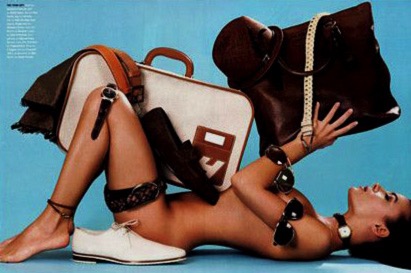
Looking at these two images, which are clearly from the same ad campaign, it is clear that the women's role in each photo is not that of a human whatsoever. They are depicted as a disturbing mix of a mannequin and a display. Both women are in almost animalistic positions, and the top woman's face is almost completely hidden. The objects these women are displaying could have easily been displayed in a way that did not rid them of their human identity or autonomy.
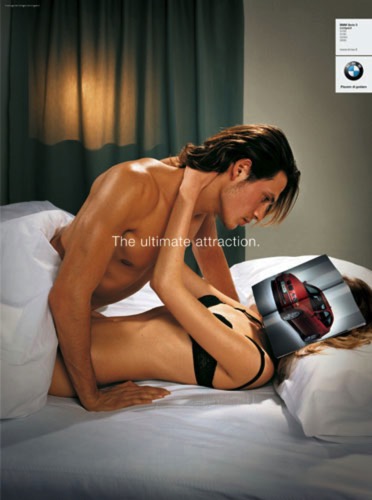
This BMW ad is equally as disturbing. Just as the first ad, the woman's face is completely obscured, but even more intentionally so in this one. Her face is covered by a magazine, opened up to a photo of a car. This is somehow more titillating and exciting for the man to look at than the woman's face. However, he has no problem using the woman's body for his own sexual gain-- just as long as he also gets to enjoy looking at a car, right? Claiming a BMW is the "ultimate attraction," and comparing it to having sex with a woman, is an outlandish ad to come up with. This is, once again, taking the humanity away from the woman by putting her one (I'm assuming just one) step below owning a BMW.
What these kinds of advertisements are doing is showing that people can view and treat women in these disrespectful ways.
That we can disrespect, taunt, and harass women:
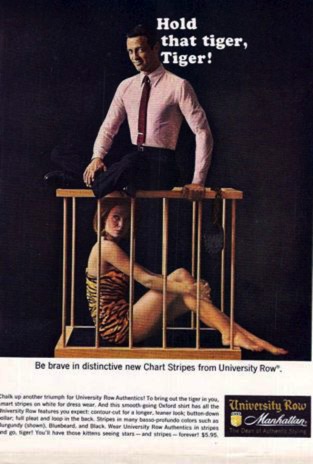
That we can treat women like animals that need to be conquered, locked up, and put in their place:
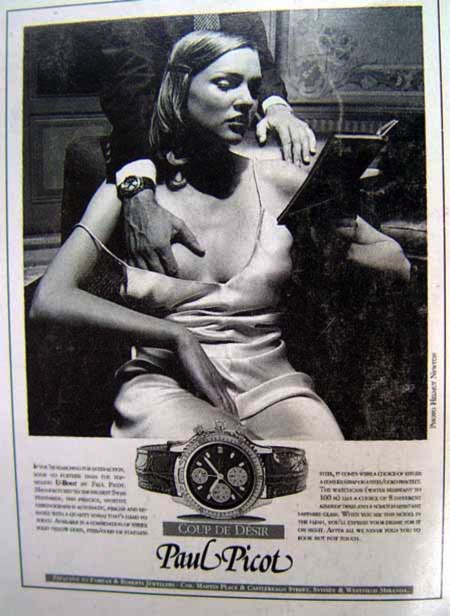
That we have the right to touch women however and whenever we want-- that we, not them, have full control over their bodies:
That we have the right to violate them and photograph their bodies for our own use:
While women's bodies may be the subjects of these ads, the women themselves are almost always treated as objects. If this is the only way the media is portraying women, then, of course, society is going to have an unhealthy view of women. Clearly, the role of women in advertising needs to be changed drastically.


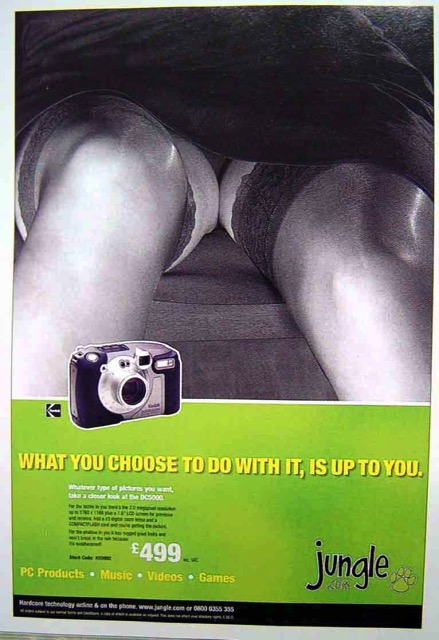
You found some good examples of women being objectified in advertisements. It bothers me that women are treated like furniture in the first two ads. The women are naked and degraded too, and are like that in almost every ad in the blog post as well. Especially the last ad, featuring an up-skirt photo! That’s disturbing, and I can’t believe a company advertised that. Why do advertisements tend to show the worst of humanity? Why can’t people advertise with good values? It seems advertisers like to use ads that use dark desires, as if they are widespread desires that most of America share? I certainly hope most of America does not desire taking pictures up my skirt without my permission and it does worry me now. A girl just can’t walk down the street without being scared anymore, even in broad daylight because what if some creep takes a picture the second my skirt blows up?
ReplyDeleteI really liked your post Rachel, companies need to take responsibility not only for the products that they sell, but also for any message sent due to how they sell it. Taking your final photo as an example. I don’t care if that is the best camera on the market, if you are telling your consumers that the best way to use your product is to violate the privacy of another person then there is something wrong with your business practices.
ReplyDeleteWhile reading, I was reminded of this article http://www.upworthy.com/the-history-of-sexist-advertising-is-being-flipped-its-amazing-but-its-not-enough that has a Suit company flipping the script on objectification in advertising. While I like the idea of a role reversal In order to draw attention to the issues for women in advertising, I am not sure if a complete role reversal is the solution.
Thanks for sharing your thoughts and the article! It is definitely bringing up an important question about how consumers and advertisers should be tackling the issue of objectification in advertising (as well as socially). I honestly am not sure where I stand on the kind of role-reversal this suit company attempted. I can see how this can be provocative and can start a conversation about the role of women in advertising, but I also see how it is still continuing this idea of reducing humans to mere objects in order to sell a product. This isn't some social experiment or art demonstration-- this is still an advertisement. What would be more effective in making change might be just not incorporating objectification at all in any adverts? At that point, it feels as ungenuine as Dove's campaign for real beauty. Are these companies really trying to make social change, or are they trying to cater to a certain market? This is always my thought process when looking at more liberal, feminist-style adverts. Because really, at the end of the day, there is still a product being pushed to consumers, and that makes me wary of companies' motives. Usually the ad misses the mark when selling a product turns to commodifying social change (Pepsi & Kendall Jenner, Dove, etc).
DeleteThis is so true and horrifying! You've got some really great examples of this advertising technique . I think it's interesting how we have the notion that "sex sells" but we rarely see the same sexual objectification with males. If we think that sex sells than they should widen the market and increase sales with male models. This shows that this is not an issue of just business . That it really does have sexist origins no matter what company's may try to say to themselves. I've noticed this trend even in products designed and targeted for women. A good example is perfume ads. Women wear them yet it seems as the ads are made for men with naked women holding the bottles or in some other strange scenario. You're right they really are missing the mark when seeling these products.
ReplyDelete